Heart Rate Variability (HRV) Explained: What It Means and How to Improve It (April 2026)
Learn what heart rate variability (HRV) measures, normal ranges by age, and research-backed ways to improve your HRV through training and recovery. April 2026.

Your heart rate variability sits at 26ms, and you're wondering if that's a problem. Your friend's reads 55ms. They're the same age. They train less. So what gives? HRV isn't a universal scorecard where higher is always better. It's a reflection of your autonomic nervous system's real-time state, shaped by sleep, training load, stress, and recovery capacity. A number that looks low in isolation might be perfectly normal for you, and a high number doesn't guarantee your nervous system is thriving. We went through the research on what HRV actually measures, how to build your personal baseline, and which interventions produce repeatable improvements. Here's what matters and what doesn't.
TLDR:
- HRV measures beat-to-beat heart rhythm variation and reflects autonomic nervous system health.
- Normal HRV declines with age: 55-75ms for men in their 20s drops to 18-35ms after 60.
- Low HRV links to higher stroke risk, cardiac death, and silent heart damage in research.
- Consistent aerobic training, 7-9 hours of sleep, and cutting alcohol raise HRV measurably.
- Track morning HRV for 14+ days to build your baseline before changing any protocol.
What Is Heart Rate Variability and Why It Matters
Heart rate variability, or HRV, measures the time gaps between successive heartbeats in milliseconds. A higher variation signals that your autonomic nervous system is responsive and adaptable. A lower variation often means the opposite.
HRV gives you a non-invasive, real-time window into how well your body is handling stress, recovery, and regulation. It reflects the balance between your sympathetic and parasympathetic nervous systems before symptoms of dysfunction ever appear.
For anyone serious about optimization, HRV belongs in your baseline toolkit alongside bloodwork and sleep data.
How the Autonomic Nervous System Controls HRV
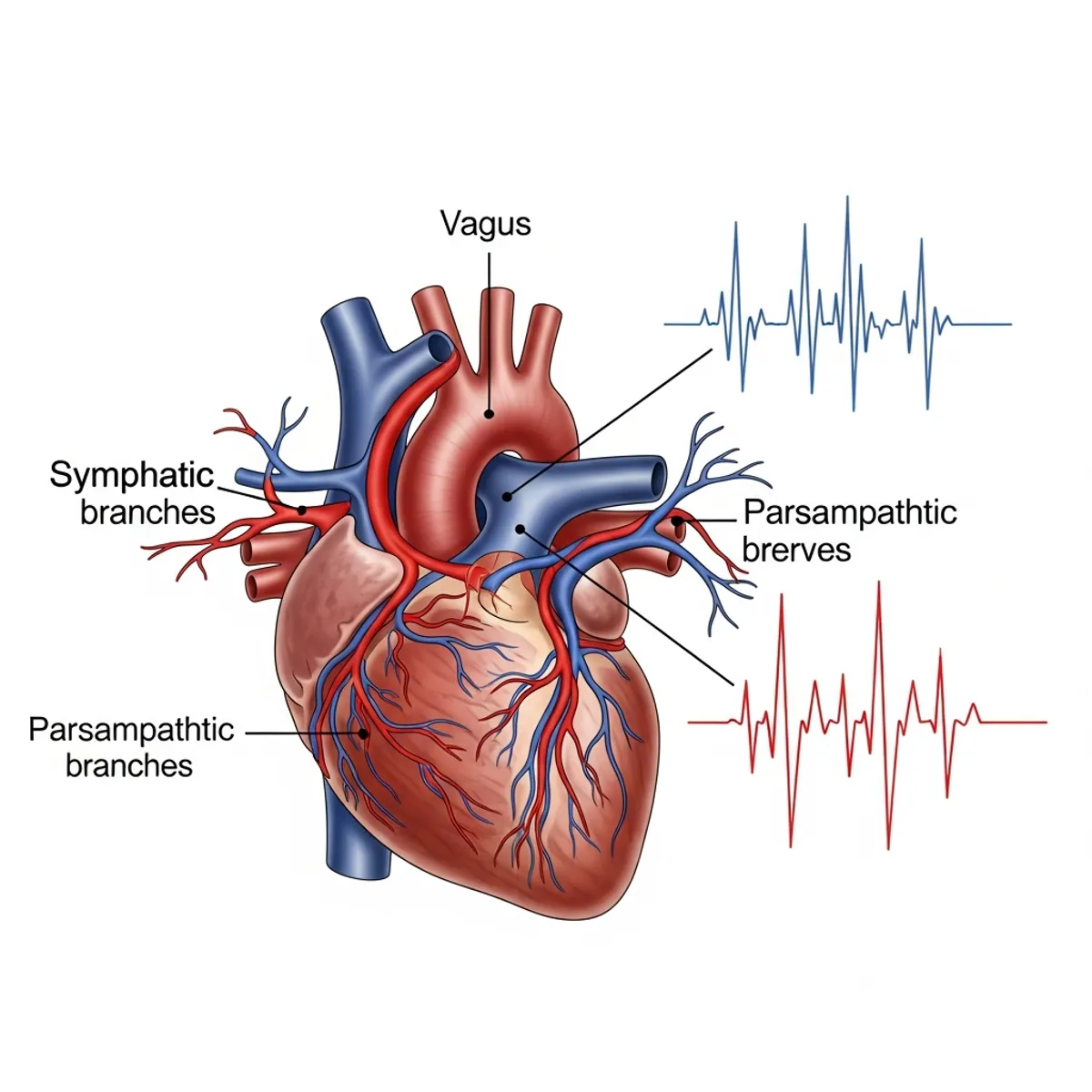
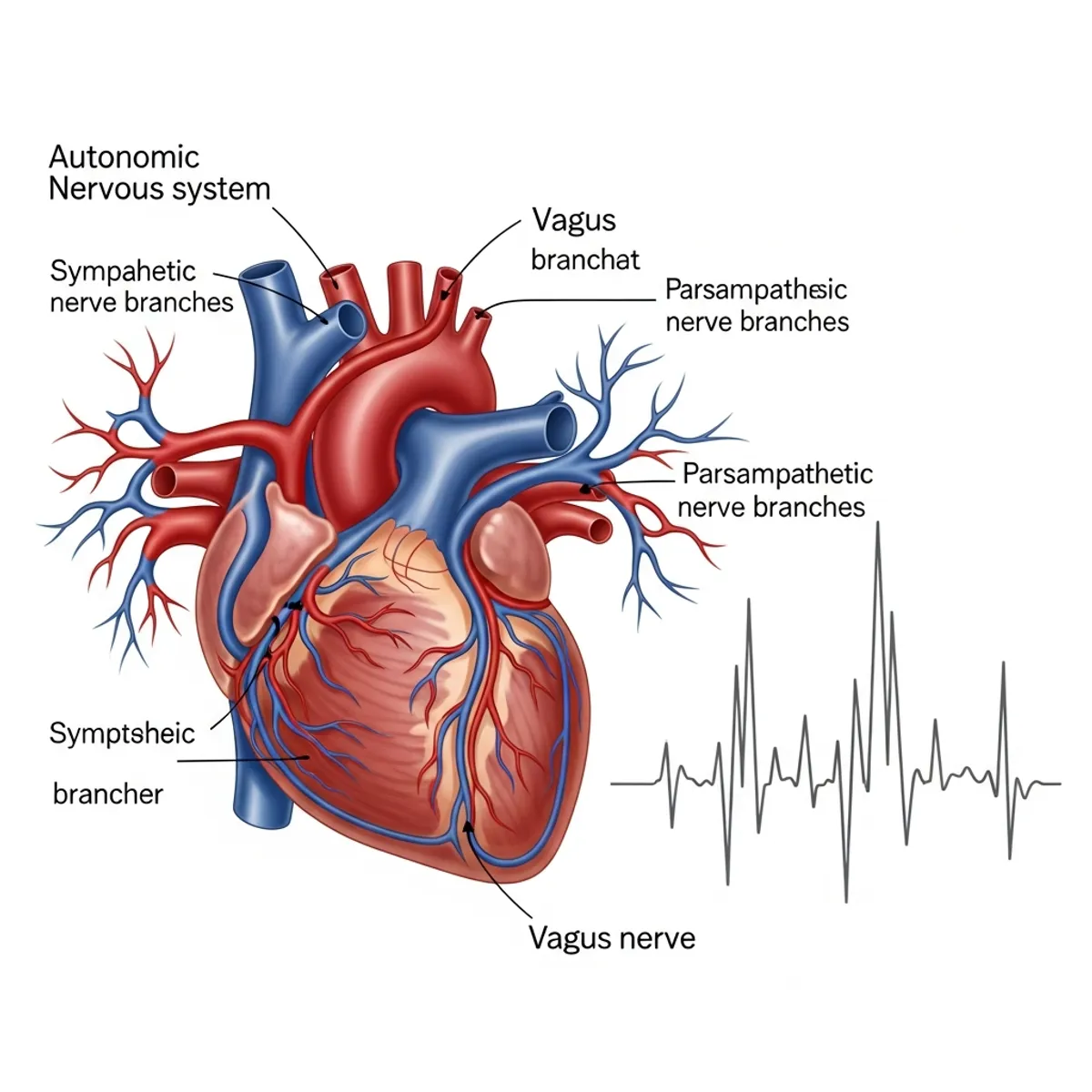
Your heart rate fluctuates continuously because two competing signals never fully stop. The sympathetic branch accelerates the heart under stress or exertion. The parasympathetic branch, driven by the vagus nerve, pulls it back down.
Research on autonomic nervous system indicators shows that HRV provides noninvasive insights into this underlying neural activity.
Healthy hearts toggle between these signals on every beat. Stronger vagal tone produces faster, more responsive parasympathetic braking and greater beat-to-beat variation.
When vagal tone weakens, sympathetic dominance narrows the rhythm toward a more fixed, metronomic pattern. Variation drops, and the nervous system loses adaptive capacity. That loss shows up in HRV readings before clinical symptoms appear, which is why researchers treat it as an early-warning health signal.
Understanding Your HRV Numbers: Normal Ranges by Age and Gender
HRV norms vary widely by age and sex. The table below reflects population-level RMSSD averages from wearable and clinical data.
HRV Normal Ranges by Age and Gender
| Age Group | Average HRV (ms) - Male | Average HRV (ms) - Female |
|---|---|---|
| 20-29 | 55-75 ms | 50-70 ms |
| 30-39 | 45-65 ms | 40-60 ms |
| 40-49 | 35-55 ms | 30-50 ms |
| 50-59 | 25-45 ms | 22-42 ms |
| 60+ | 18-35 ms | 15-30 ms |
HRV declines with age as autonomic nervous system function changes over time. Women tend to read slightly lower than men in the same age bracket, though the gap narrows after menopause. Comparing your number to age and sex-matched peers is far more informative than chasing a single universal target.
Low HRV: What It Means and When to Be Concerned
Low HRV is relative, primarily to your own baseline. A reading consistently 20% or more below your personal average is worth paying attention to.
Common causes of chronically low HRV include:
- Chronic psychological or physiological stress
- Poor or insufficient sleep
- Overtraining without adequate recovery
- Active illness or infection
- Alcohol consumption
- Underlying cardiovascular dysfunction
The clinical research is sobering. Reduced HRV indices are associated with higher stroke risk, sudden cardiac death, and greater mortality following myocardial infarction. In patients with diabetes or hypertension, low HRV is also linked to a greater likelihood of silent myocardial ischaemia, meaning cardiac compromise with no obvious symptoms.
A single low reading rarely signals something serious. Hard training, disrupted sleep, or alcohol the night before can all suppress HRV temporarily. The trend matters far more than any individual data point. Chronically suppressed HRV that fails to recover after rest, or a sharp unexplained drop in someone with known cardiovascular risk factors, warrants a conversation with a physician.
HRV During Sleep: Your Nightly Recovery Window
Sleep is the cleanest window for measuring HRV because external stressors drop away and your nervous system runs without interference. During slow-wave deep sleep, parasympathetic activity peaks and HRV climbs to its highest point of the day. REM sleep is noisier: dreaming activates mixed autonomic activity, so HRV fluctuates more irregularly across that stage.
Wearables like Oura and WHOOP calculate overnight HRV by averaging readings across these stages instead of capturing a single snapshot. A full eight hours of sleep with a consistently suppressed overnight HRV often signals incomplete restoration, whether from accumulated training stress, illness, or unresolved psychological load.
How to Measure HRV Accurately
Three measurement approaches exist, each with meaningful accuracy tradeoffs. A clinical 12-lead ECG is the gold standard but impractical for daily tracking. Chest strap monitors like the Polar H10 come closest to ECG accuracy in real-world use, capturing beat-to-beat intervals reliably enough for RMSSD and SDNN calculation. Optical wrist sensors on devices like the Apple Watch, Garmin, WHOOP, and Oura Ring are convenient but introduce more signal noise, particularly during movement.
The Main HRV Metrics
- RMSSD: The root mean square of successive beat differences, the most common wearable metric and the best proxy for parasympathetic activity.
- SDNN: Standard deviation of all R-R intervals over a recording period, reflecting total autonomic variability.
- Frequency domain measures: LF/HF power ratios used primarily in clinical and research settings.
Consistency matters as much as device choice. Morning readings taken immediately after waking, before getting out of bed, produce the most stable baseline. The trend is the signal. Fourteen or more days of morning readings reveals your personal baseline, making deviations interpretable.
Evidence-Based Strategies to Improve Your HRV
Here are the most research-backed approaches to raising HRV over time.
Consistent Aerobic Exercise
Regular moderate-intensity cardio is among the most reliably studied HRV interventions. Endurance athletes consistently show higher resting HRV than sedentary individuals across age groups.
Sleep Quality and Duration
HRV peaks during deep sleep stages. Targeting 7 to 9 hours, maintaining consistent sleep timing, and reducing pre-sleep alcohol intake all produce measurable improvements.
Slow-Paced Breathing
Breathing at roughly 5 to 6 breaths per minute activates the parasympathetic nervous system and produces acute HRV increases. Even short daily sessions show cumulative benefit.
Stress Reduction
Chronic psychological stress suppresses vagal tone. Meditation, HRV biofeedback, and cold exposure have each shown positive effects in controlled studies, though effect sizes vary.
Alcohol Reduction
Even moderate alcohol consumption measurably suppresses overnight HRV. Eliminating it entirely tends to produce noticeable improvements within days.
Using HRV to Optimize Training and Recovery
HRV reflects total stress load beyond training volume alone. A suppressed morning reading after an easy day signals something different than the same number after back-to-back hard sessions: one suggests incomplete recovery, the other points to sleep debt, nutrition gaps, or emotional strain. The data looks identical, so context is everything.
HRV-guided training uses this to modulate intensity in real time instead of following a fixed plan regardless of how your nervous system responds. Studies on HRV training adaptation confirm that HRV is a helpful metric to assess training status, adaptability, and recovery after a training program. A practical framework:
- HRV 10% or more above your rolling average: ready for high-intensity work
- HRV within 5% of baseline: moderate training is appropriate
- HRV more than 10% below baseline: recovery work or rest only
Travel, poor sleep, relationship stress, and caloric deficit all register in HRV before they appear as injury or illness.
Tracking HRV as Part of Your Biohacking Protocol
HRV fits naturally alongside CGMs, bloodwork panels, and sleep data as part of a measurement-first protocol. No single biomarker tells the whole story, but HRV updates daily, captures total stress load in real time, and responds visibly to nearly every intervention you introduce.
Before starting a new training block, peptide protocol, or dietary change, collect at least two weeks of morning HRV readings as your baseline. Then watch what happens. HRV trending upward after four weeks of consistent aerobic work confirms the intervention is working. A persistent drop after introducing a new compound is worth taking seriously before you continue.
That feedback loop is what measurement-first actually looks like: objective data replacing guesswork with something you can act on.
Final Thoughts on HRV and Nervous System Health
Tracking heart rate variability gives you an objective read on autonomic nervous system function without waiting for clinical symptoms to surface. Build a two-week baseline, measure at the same time daily, and focus on the trend instead of daily noise. HRV responds to sleep quality, training load, stress, and nearly every intervention you introduce, which makes it one of the most actionable biomarkers available for real-time optimization.
FAQ
What is a normal HRV while sleeping?
Normal sleeping HRV varies by age and sex, but generally peaks during deep sleep stages when parasympathetic activity is highest. For reference, men aged 20-29 average 55-75 ms during waking baseline measurements, while women in the same age group average 50-70 ms. Overnight readings tend to run higher than these baselines since sleep removes external stressors and allows vagal tone to dominate.
Apple Watch HRV vs chest strap monitor: which should I trust?
Chest strap monitors like the Polar H10 come closest to clinical ECG accuracy for beat-to-beat interval capture, making them more reliable for precise RMSSD and SDNN calculation. Optical wrist sensors on the Apple Watch introduce more signal noise, particularly during movement, but remain useful for tracking trends over time as long as you measure consistently under the same conditions.
What is a dangerously low HRV?
A single low reading rarely signals danger. Hard training, disrupted sleep, or alcohol can all suppress HRV temporarily. Chronically suppressed HRV that fails to recover after rest, or a sharp unexplained drop in someone with known cardiovascular risk factors, warrants a physician conversation since reduced HRV is linked to higher stroke risk, sudden cardiac death, and greater mortality following heart attack.
How to improve HRV fast?
Consistent aerobic exercise, 7-9 hours of quality sleep, and eliminating alcohol produce the most reliable HRV improvements in the research. Slow-paced breathing at 5-6 breaths per minute activates parasympathetic tone and shows measurable acute increases, with cumulative benefit from daily practice. The trend matters more than any single intervention, so build a two-week baseline before changing variables.
Can your HRV be too high?
Extremely high HRV in the context of normal age and fitness level is rare but can reflect overtraining syndrome or certain cardiac conduction abnormalities. For most people, higher HRV within normal population ranges signals better autonomic balance and recovery capacity. Context matters more than the absolute number, so compare your reading to your own baseline and age-matched norms instead of chasing a universal target.
Frequently asked questions
- 01 What is a normal HRV while sleeping?
- Normal sleeping HRV varies by age and sex, but generally peaks during deep sleep stages when parasympathetic activity is highest. For reference, men aged 20–29 average 55–75 ms during waking baseline measurements, while women in the same age group average 50–70 ms—overnight readings tend to run higher than these baselines since sleep removes external stressors and allows vagal tone to dominate.
- 02 Apple Watch HRV vs chest strap monitor—which should I trust?
- Chest strap monitors like the Polar H10 come closest to clinical ECG accuracy for beat-to-beat interval capture, making them more reliable for precise RMSSD and SDNN calculation. Optical wrist sensors on the Apple Watch introduce more signal noise, particularly during movement, but remain useful for tracking trends over time as long as you measure consistently under the same conditions.
- 03 What is a dangerously low HRV?
- A single low reading rarely signals danger—hard training, disrupted sleep, or alcohol can all suppress HRV temporarily. Chronically suppressed HRV that fails to recover after rest, or a sharp unexplained drop in someone with known cardiovascular risk factors, warrants a physician conversation since reduced HRV is linked to elevated stroke risk, sudden cardiac death, and higher mortality following heart attack.
- 04 How to improve HRV fast?
- Consistent aerobic exercise, 7–9 hours of quality sleep, and eliminating alcohol produce the most reliable HRV improvements in the research. Slow-paced breathing at 5–6 breaths per minute activates parasympathetic tone and shows measurable acute increases, with cumulative benefit from daily practice—but the trend matters more than any single intervention, so establish a two-week baseline before changing variables.
- 05 Can your HRV be too high?
- Extremely high HRV in the context of normal age and fitness level is rare but can reflect overtraining syndrome or certain cardiac conduction abnormalities. For most people, higher HRV within normal population ranges signals better autonomic balance and recovery capacity—context matters more than the absolute number, so compare your reading to your own baseline and age-matched norms rather than chasing a universal target.
- 06 What does it mean if my HRV is 20ms or lower?
- HRV of 20ms or lower is below population averages for most age groups and suggests limited autonomic flexibility. This reading is common in people over 60, those experiencing chronic stress, or individuals with cardiovascular risk factors—but context matters more than the absolute number, so compare it to your personal baseline and recent sleep quality, training load, and stress levels before concluding something is wrong.
- 07 Should I train hard when my HRV drops 15% below baseline?
- No—a 15% drop below your rolling average signals incomplete nervous system recovery and increased injury or illness risk. Limit training to low-intensity recovery work or rest entirely until HRV returns to within 5% of baseline, since pushing through suppressed readings compounds stress rather than building adaptation.
- 08 HRV biofeedback vs slow breathing—which improves HRV faster?
- Both produce measurable parasympathetic activation, but slow-paced breathing at 5-6 breaths per minute is simpler to implement and shows acute HRV increases within minutes of practice. HRV biofeedback adds real-time visual feedback to breathing exercises and may accelerate skill development, though the breathing pattern itself drives most of the benefit.
- 09 Can I use HRV to tell if I'm overtraining?
- Yes—chronically suppressed morning HRV that fails to recover after rest days is one of the earliest detectable signs of overtraining syndrome. Track your rolling 7-day average and watch for sustained drops of 10% or more that persist despite adequate sleep and nutrition, since HRV reflects total stress load before performance decline or injury symptoms appear.
- 10 What causes HRV to drop during sleep even when I feel rested?
- Alcohol consumption, late meals, sleep apnea, and REM-dominant sleep architecture all suppress overnight HRV even when subjective sleep quality feels adequate. Active immune responses to subclinical infection or inflammation also reduce parasympathetic tone during sleep before symptoms become noticeable, making overnight HRV a useful early-warning signal.
- 11 Does HRV accuracy matter if I'm only tracking trends?
- Device accuracy matters less for trend tracking than measurement consistency—using the same device, at the same time, under the same conditions produces reliable directional data even if absolute RMSSD values carry measurement error. Chest straps give more precise beat-to-beat intervals than optical wrist sensors, but either works for spotting meaningful changes in your personal baseline over time.
- 12 What's the best time of day to measure HRV for baseline tracking?
- Measure immediately after waking, before getting out of bed, while still in a fasted and unstimulated state. Morning readings capture parasympathetic tone without confounding variables like caffeine, food, movement, or psychological stress that accumulate throughout the day—consistency at this measurement window produces the cleanest baseline data.
- 13 HRV training zones vs RPE—which should I follow?
- HRV provides objective autonomic readiness data that RPE cannot capture, making it superior for detecting hidden stress from sleep debt, nutrition gaps, or emotional strain. Use HRV to modulate training intensity on a given day, then apply RPE within that session to guide effort levels—the combination prevents both undertraining when recovered and overreaching when compromised.
- 14 Can meditation improve HRV if aerobic training already maxed it out?
- Yes—meditation and slow breathing activate parasympathetic pathways through different mechanisms than aerobic conditioning, so they can produce additional HRV gains even in trained individuals. Studies show mindfulness practices improve vagal tone independently of cardiovascular fitness, though effect sizes are smaller than those from consistent endurance work in previously sedentary people.
- 15 What HRV drop should trigger a rest day in an athlete?
- A drop of 10% or more below your rolling 7-day average warrants replacing high-intensity work with recovery activities or complete rest. The exact threshold varies by individual baseline variability and training phase, so establish your personal response pattern over 4-6 weeks of paired HRV and training data before making rigid cutoff rules.