
CJC-1295 and Ipamorelin: Research and Stack Guide June 2026
Our June 2026 guide to the CJC-1295 and ipamorelin stack covers dual-receptor GH release, IGF-1 findings, safety data, and current regulatory status in the US.

The CJC-1295 ipamorelin stack gets described in a lot of places, but most of those descriptions skip the part that makes it worth studying in the first place: these two growth hormone peptides hit different receptors through different signaling pathways, and that's what produces the additive GH output researchers are actually interested in. We read the primary studies so you can get a clear picture of what's supported and what's still speculation.
TLDR:
- CJC-1295 and ipamorelin target separate receptors, producing additive GH output that exceeds either compound alone.
- One 2006 trial found CJC-1295 raised IGF-1 by 72-111% over 28 days. No replication in healthy adults exists.
- Ipamorelin raises GH without the cortisol and prolactin spikes seen with GHRP-2 and GHRP-6.
- Neither peptide is FDA-approved; both are classified as research compounds with restricted compounding access in the US.
- BioHackLabsHq reviews primary trial data on this stack and reports where the evidence holds and where it runs thin.
What CJC-1295 Is
CJC-1295 is a synthetic analog of growth hormone-releasing hormone (GHRH), the peptide your hypothalamus produces to signal the pituitary gland to release growth hormone. Its defining feature is Drug Affinity Complex (DAC) tech, a structural modification that lets the peptide bind covalently to serum albumin in the bloodstream, extending its half-life from a few minutes to several days.
One naming issue is worth sorting out early. "CJC-1295" appears in two forms across research literature. CJC-1295 with DAC is the long-acting, albumin-binding version. Modified GRF 1-29, often called CJC-1295 without DAC, has a much shorter half-life and produces a more pulsatile GH release pattern closer to natural physiology. The two behave differently, so knowing which version a study references matters.
What Ipamorelin Is
Ipamorelin is a synthetic pentapeptide that acts as a selective ghrelin receptor agonist. It binds to the growth hormone secretagogue receptor (GHS-R), prompting the pituitary to release growth hormone in a pulsatile pattern that mirrors the body's natural secretion rhythm.
What sets ipamorelin apart from older secretagogues is its selectivity. It raises GH without meaningfully increasing cortisol or prolactin, which are common side effects with less selective compounds.
How It Differs from Other Secretagogues
Ipamorelin's selectivity profile makes it a preferred research subject for GH optimization studies, particularly when combined with GHRH analogs like CJC-1295.
- Minimal cortisol elevation compared to GHRP-2 and GHRP-6, which both produce measurable cortisol spikes at standard doses
- No meaningful prolactin increase, unlike several first-generation GHRPs that carry prolactin-related side effect risk
- Short half-life of roughly 2 hours, producing discrete GH pulses instead of continuous elevation
Why Researchers Combine CJC-1295 and Ipamorelin
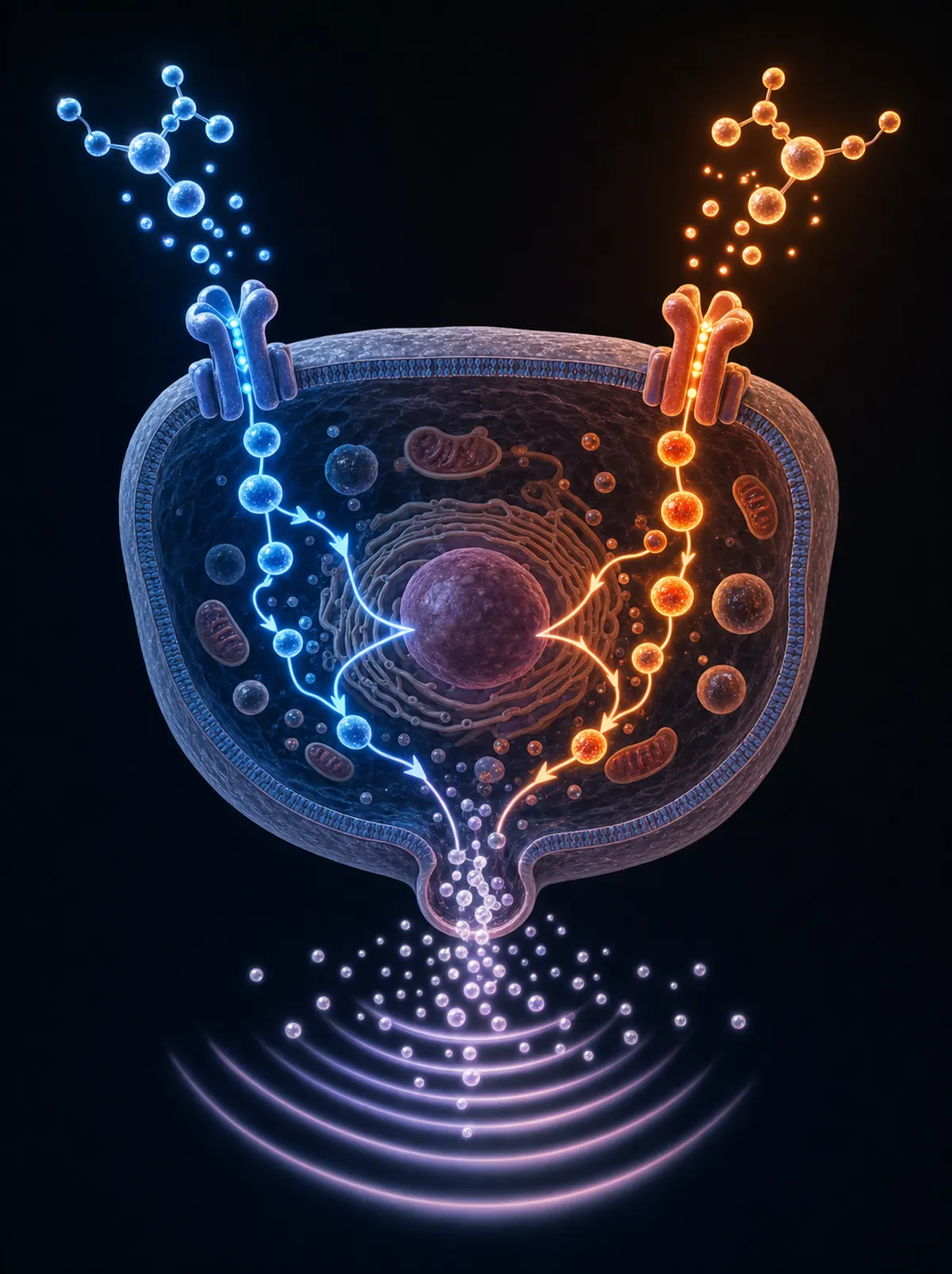
CJC-1295 binds the GHRH receptor and triggers a cAMP-dependent cascade, raising the baseline of GH secretion. Ipamorelin activates the GHS-R1a receptor through a separate calcium-dependent pathway, amplifying the peak amplitude of each natural GH pulse.
These two compounds target different receptors on the same pituitary cell. When both pathways are activated together, preclinical and mechanistic data suggest the resulting GH output exceeds what either compound produces in isolation, a key topic in biohacking research. CJC-1295 raises the floor of secretion while ipamorelin pushes each pulse higher, and that complementary relationship is the core rationale for studying them as a stack.
What the Clinical Research Shows
The strongest human evidence comes from a handful of small controlled trials, not large-scale RCTs. A 2006 study found that CJC-1295 produced dose-dependent increases in GH levels of 2 to 10-fold over baseline, with IGF-1 rising 1.5 to 3-fold and remaining above baseline for up to 14 days after a single injection. Ipamorelin's research profile shows clean GH pulse amplification with minimal cortisol or prolactin spillover. The combination appears to produce additive GH release, though direct human trials on the stack remain limited.
Claimed Benefits and the Evidence Behind Each One
The CJC-1295 and ipamorelin stack is researched for several overlapping goals. Here is what the evidence actually supports for each one.
Growth Hormone and IGF-1 Elevation
Both peptides target the growth hormone axis from different angles, and the combination produces additive effects on GH pulse amplitude. One study found CJC-1295 alone raised IGF-1 levels by 72 to 111% over 28 days across dose groups. That is a single trial with no long-term replication in healthy adults, a limitation familiar from rapamycin longevity research as well.
Body Composition
Animal models show favorable changes in lean mass and fat reduction with GH secretagogues. Human data in this area is thinner, mostly drawn from GH-deficient populations and not from healthy adults pursuing optimization. No controlled trials in healthy adults have directly tested the CJC-1295 ipamorelin stack for body composition outcomes. The applicability of GH-deficient population data to healthy adults has no confirmed evidentiary basis.
Sleep Quality
Ipamorelin's action on ghrelin receptors may influence slow-wave sleep, where natural GH secretion peaks. The mechanistic basis draws from ghrelin's known role in sleep architecture regulation. No controlled human trials have tested ipamorelin for this outcome in isolation. Treat this as speculative until direct trial data exists.
Recovery
GH and IGF-1 both play roles in tissue repair and longevity. The inference that raising them accelerates recovery is biologically grounded, though direct clinical evidence specific to this stack is lacking.
Side Effects and Known Safety Data
Injection site reactions, headache, and transient water retention are the most commonly reported adverse effects. In Phase I trials, CJC-1295 with DAC produced no serious adverse events at doses between 30 and 60 µg/kg, though gastrointestinal complaints increased at higher doses.
Both peptides carry a meaningfully different risk profile when compounded outside approved pharmaceutical settings. Controlled trials use pharmaceutical-grade compounds with verified purity and sterility. One safety analysis outlines the specific concerns around compounded versions, and that gap in quality control is material, a concern that also applies to BPC-157 and similar research compounds.
Who Should Approach This Stack with Extra Caution
This stack warrants extra thought for certain groups. People with active cancer or a history of hormone-sensitive malignancies should avoid GH-stimulating peptides, as raised IGF-1 has been linked to accelerated tumor growth in preclinical models. Individuals with untreated hypothyroidism may see blunted results, since GH secretion and thyroid function interact closely. Those with diabetes or impaired glucose regulation should monitor blood sugar carefully, as GH can reduce insulin sensitivity. Pregnant or breastfeeding individuals have no safety data to reference here and should avoid use entirely.
Regulatory Status and What It Means for Access
Neither CJC-1295 nor ipamorelin is FDA-approved for human use outside of clinical trials. Both are classified as research compounds in the United States, meaning they are legal to study but not legal to prescribe or sell as finished drug products. The FDA has also moved to restrict compounding pharmacies from producing them, narrowing legitimate access further. In other regions, rules vary considerably. Anyone considering this stack should verify current regulations in their jurisdiction before pursuing access, and it is worth reviewing the real benefits and trade-offs of biohacking more broadly.
How CJC-1295 and Ipamorelin Compare to Other Growth Hormone Peptides
The CJC-1295 and ipamorelin stack sits in a distinct category among growth hormone peptides. CJC-1295 is a GHRH analogue, while ipamorelin is a ghrelin mimetic, meaning they work through separate receptor pathways. Most alternatives operate through only one of these mechanisms.
Sermorelin is the closest GHRH analogue comparator but has a much shorter half-life than CJC-1295 with DAC, requiring more frequent dosing. GHRP-6 and GHRP-2 share ipamorelin's ghrelin-mimetic mechanism but produce stronger cortisol and prolactin elevations, which ipamorelin largely avoids.
| Peptide | Mechanism | Key Tradeoff |
|---|---|---|
| Sermorelin | GHRH analogue | Short half-life, frequent dosing |
| GHRP-6 | Ghrelin mimetic | Notable appetite increase, cortisol rise |
| GHRP-2 | Ghrelin mimetic | Stronger GH pulse, higher cortisol and prolactin |
| Ipamorelin | Ghrelin mimetic | Cleaner hormonal profile with smaller GH pulse |
| CJC-1295 | GHRH analogue | Prolonged GH elevation via extended half-life |
The CJC-1295 and ipamorelin combination is often favored in research protocols for producing synergistic GH release with a comparatively clean side-effect profile.
Frequently Asked Questions
Eight questions asked frequently about this stack, answered directly from the research.
How long does it take to see results?
IGF-1 changes in CJC-1295 studies appeared within days and persisted up to 14 days post-injection. Functional outcomes like body composition or recovery changes, if they occur, would take weeks to months, closer to the timeframe covered in a beginner biohacking protocol. No controlled timeline data exists for the combined stack.
Is this the same as taking synthetic HGH?
No. These peptides stimulate your pituitary to produce GH instead of replacing it directly. The pituitary's own feedback loops remain active, which is a meaningful physiological difference from exogenous HGH administration.
Are ipamorelin and sermorelin interchangeable?
They are not. Sermorelin is a GHRH analogue like CJC-1295, acting on the same receptor. Ipamorelin is a ghrelin mimetic acting on a separate receptor. Swapping ipamorelin for sermorelin gives you two compounds hitting the same pathway, not two complementary ones.
What does "with DAC" vs "without DAC" mean in practice?
CJC-1295 with DAC binds serum albumin and stays active for several days, producing a prolonged rise in GH secretion. Without DAC (Modified GRF 1-29), the half-life drops to minutes and GH release follows a more pulsatile pattern closer to natural physiology. The two behave differently enough that any study referencing "CJC-1295" without specifying which version is citing incomplete data.
What makes ipamorelin a better research candidate than GHRP-2 or GHRP-6 for a growth hormone peptide stack?
Ipamorelin raises GH without meaningfully increasing cortisol or prolactin, which are side effects both GHRP-2 and GHRP-6 produce at standard doses. That cleaner hormonal profile is the primary reason the CJC-1295 ipamorelin stack appears more frequently in GH optimization research than older ghrelin mimetics. If cortisol and prolactin spillover matter to your protocol, the selectivity difference is material.
How does the CJC-1295 and ipamorelin stack produce more GH than either peptide alone?
CJC-1295 activates the GHRH receptor through a cAMP-dependent pathway, raising the baseline of GH secretion. Ipamorelin activates the GHS-R1a receptor through a separate calcium-dependent pathway, amplifying the peak amplitude of each GH pulse. Because they work on different receptors on the same pituitary cell, the combined output exceeds what either compound produces in isolation.
What does the human clinical research on CJC-1295 actually show?
A 2006 controlled trial found CJC-1295 produced dose-dependent GH increases of 2 to 10-fold over baseline, with IGF-1 rising 72 to 111 percent across dose groups and remaining above baseline for up to 14 days after a single injection. That is one trial with no long-term replication in healthy adults. Direct human trials on the combined CJC-1295 ipamorelin stack remain limited, and body composition or recovery outcomes in healthy populations lack controlled trial support.
Should someone with a history of cancer avoid growth hormone peptides like CJC-1295 and ipamorelin?
Yes. People with active cancer or a history of hormone-sensitive malignancies should avoid GH-stimulating peptides entirely. High IGF-1 has been linked to accelerated tumor growth in preclinical models, and that risk profile applies to any compound that raises GH output, including the full CJC-1295 ipamorelin stack.
How BioHackLabsHq Covers CJC-1295 and Ipamorelin
We read the primary research on CJC-1295 and ipamorelin before publishing anything about them. That means reviewing the actual trial data, not secondary summaries, and being direct about where the evidence is strong and where it runs thin. If a finding comes from a single small study with no replication, we say so. If the data genuinely supports a claim, we make it without hedging. Our goal is to give you the clearest, most accurate picture of what this stack does and what the science actually supports.
Final Thoughts on Growth Hormone Peptides Like CJC-1295 and Ipamorelin
For a stack this frequently discussed, the controlled human trial data is thinner than most sources let on. The dual-receptor rationale is solid, and the IGF-1 findings from CJC-1295 trials are worth taking seriously. Your best move is to read the primary research, know the regulatory status where you are, and keep your expectations calibrated to what the evidence actually shows.
Frequently asked questions
- 01 What can wearables do ?
- It can track longevity metrics